LOVE OF CHROMATIC HARMONICA...Techniques and Advice From The World's Best! by Cohen Frederica & Kettlewell David
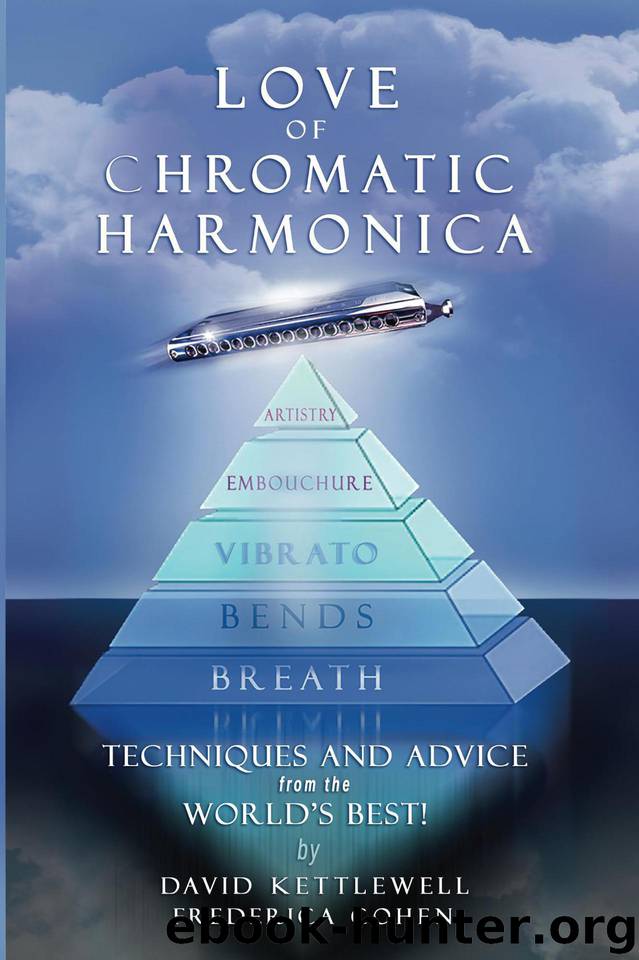
Author:Cohen, Frederica & Kettlewell, David [Cohen, Frederica]
Language: eng
Format: epub
Publisher: Unknown
Published: 2015-08-08T16:00:00+00:00
LEO HO... HONG KONG, CHINA
Leo Ho ( Leo Ho Cheuk-yin, age 20) of Hong Kong is one of the most singular and uniquely-talented young chromatic harmonica players in the world today. He has excelled at playing repertoire which has vexed and puzzled musicians on all instruments in the last half century… and I speak here of the masterpieces written by Astor Piazzolla, the composer on bandoneon (that devilish box of wiggling bellows with buttons) who redefined Argentinean Tango… creating a new genre that revolutionized this cherished treasure. Playing Piazzolla’s pieces correctly, with the intense and on-the-nose timing Piazzolla evidenced has proven next to impossible for most musicians, regardless of talent and training. It has been said that of all the musicians in the world who have attempted to play Piazzolla’s music, Leo has come closest to reflecting this consummate composer’s original intentions .
His credits are so long we are unable to print them all here… but suggest you read of his many awards at http://www. playhohner.com/artists/leo-ho-cheuk-yin. (Bring along cookies and tea, it will take you some time to read his bio. His version of Piazzolla’s Invierno Porteno on Youtube is a must-see.
Leo is included in the prestigious listing of Hohner “Masters of the Harmonica.”
Interviewer: I wanted to start off by complimenting you: Astor Piazzolla, from my experience, is the hardest composer to play with anything resembling his original sound, and I think the reason for this is that Astor was a very confident musician who played either right on the head on the rhythm, or even a hair ahead to create this tension, and many a listener have been sorely disappointed in those musicians who have trod this road, and attempted Piazzolla on piano, bandoneon, or violin. Yours is the first rendition I’ve heard that actually captures the intent of his sound on his piece, Invierno Porteno. That was an incredible accomplishment on your part as a player, but also as an arranger.
Thank you very much.
Interviewer: Let’s talk a little bit about Astor Piazzolla. How did you accomplish what you did with that piece of music? Please explain it to us… how did you understand his music-to begin with? How did you go about creating your own arrangements, and what do you think the secrets are, or the techniques which are required to play Astor Piazzolla’s music (in this instance Invierno Porteno) properly?
In preparing for a competition, I always do a lot of research on the background of the composer/performer; in this case, Astor Piazzolla, and study all the notes and articulations in the score very carefully. I also view as many existing arrangements or videos on YouTube as I can find.
Yes, Piazzolla is playing Tango, but it is definitely not traditional Tango… it is something “new” to the Tango tradition. I am currently a member of the “303 Tango Fusion Band,” and they explained to me that Astor Piazzolla is somewhat controversial… as Tango dancers find his music problematic, because they cannot dance to it easily.
(Note: Piazzolla revolutionized Tango,
Download
This site does not store any files on its server. We only index and link to content provided by other sites. Please contact the content providers to delete copyright contents if any and email us, we'll remove relevant links or contents immediately.
The Goal (Off-Campus #4) by Elle Kennedy(13638)
Kathy Andrews Collection by Kathy Andrews(11793)
Diary of a Player by Brad Paisley(7537)
What Does This Button Do? by Bruce Dickinson(6185)
Assassin’s Fate by Robin Hobb(6183)
Big Little Lies by Liane Moriarty(5768)
Altered Sensations by David Pantalony(5085)
Pale Blue Dot by Carl Sagan(4978)
Sticky Fingers by Joe Hagan(4167)
The Death of the Heart by Elizabeth Bowen(3591)
The Heroin Diaries by Nikki Sixx(3532)
Beneath These Shadows by Meghan March(3287)
Confessions of a Video Vixen by Karrine Steffans(3287)
How Music Works by David Byrne(3245)
The Help by Kathryn Stockett(3129)
Jam by Jam (epub)(3066)
Harry Potter 4 - Harry Potter and The Goblet of Fire by J.K.Rowling(3041)
Computational Linguistics and Intelligent Text Processing: 20th International Conference, CICLing 2019 La Rochelle, France, April 7â13, 2019 Revised Selected Papers, Part I by Alexander Gelbukh(2974)
Strange Fascination: David Bowie: The Definitive Story by David Buckley(2848)
